How to Integrate a Wine Cooler into Your Modern Kitchen: Design, Assembly, and Manufacturing Insights from China
Modern kitchens are no longer designed simply for cooking. For homeowners, interior designers, developers, hospitality businesses, and appliance brands, the kitchen has become an integrated lifestyle space where food preparation, entertaining, wine storage, and premium appliances come together.
A built-in wine cooler can play an important role in this modern kitchen concept. When properly integrated into cabinetry, a wine cooler can provide professional wine storage while maintaining a clean, seamless appearance.
But creating a successful built-in wine cooler solution involves much more than choosing an attractive appliance. Cabinet dimensions, ventilation, door clearance, hinge design, shelving, cooling technology, materials, and manufacturing precision all need to work together.
This is where an experienced wine cooler manufacturer can make a significant difference.
Foshan Shunde Wiki Electrical Co., Ltd. (WIKI) is a professional Chinese refrigeration manufacturer specializing in built-in and freestanding refrigeration appliances. Established in 2014, WIKI has more than a decade of experience in the research, development, manufacturing, and international supply of wine coolers and related refrigeration products.
For global brands, distributors, importers, and OEM/ODM customers, WIKI provides not only wine cooler products but also customized manufacturing and engineering support.
1. Why Integrate a Wine Cooler into a Modern Kitchen?
A freestanding wine cooler can be convenient, but built-in installation offers a more sophisticated approach for modern kitchen design.
A properly integrated wine cooler can be installed underneath a countertop, alongside kitchen cabinets, within a kitchen island, or as part of a larger appliance wall.
The result is a more unified appearance.
Instead of looking like an independent appliance, the wine cooler becomes part of the overall kitchen architecture.
Key benefits include:
- · Better use of available kitchen space
- · A cleaner and more integrated appearance
- · Easy access to wine during entertaining
- · Improved coordination with kitchen cabinetry
- · Greater design flexibility
- · A premium appearance suitable for high-end residential projects
For appliance brands and kitchen manufacturers, built-in wine coolers can also create opportunities for premium product lines.
2. Start with the Kitchen — Not the Wine Cooler
One of the most common mistakes when planning a built-in wine cooler is choosing the appliance first and considering the cabinet afterward.
The better approach is to consider the entire installation system.
Before selecting a wine cooler, designers and buyers should consider:
Cabinet Opening Dimensions
The width, height, and depth of the cabinet opening must correspond to the wine cooler's external dimensions and installation requirements.
Common under-counter configurations are designed around standardized kitchen dimensions, while other projects may require narrower, taller, or customized wine coolers.
This is particularly important for OEM/ODM projects because product dimensions can influence the entire kitchen cabinet structure.
Ventilation
Compressor-based wine coolers generate heat during operation.
Therefore, ventilation must be considered during the design stage. Depending on the product structure, the ventilation grille may be positioned at the front, bottom, rear, or another engineered location.
For built-in products, manufacturers need to consider airflow, heat dissipation, compressor placement, insulation, and cabinet integration together.
A visually attractive wine cooler is not enough if the installation environment cannot support reliable cooling performance.
Door Opening and Clearance
The door needs sufficient clearance to open properly without interfering with adjacent cabinets or appliances.
Hinge position and door structure are therefore important parts of the installation design.
For premium kitchens, even a small mismatch between the door and surrounding cabinetry can affect the overall appearance.
3. Choosing the Right Wine Cooler Configuration
Not every kitchen requires the same wine cooler.
The appropriate configuration depends on the user's wine collection, available space, target market, and installation environment.
Single-Zone Wine Cooler
A single-zone wine cooler provides one temperature-controlled storage area and is suitable for users who primarily store one type of wine or prefer a simpler storage configuration.
Dual-Zone Wine Cooler
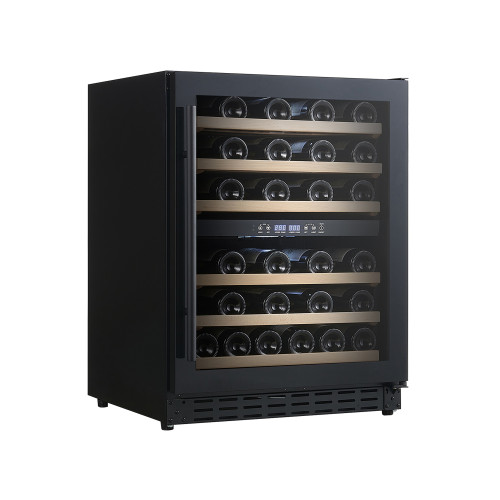
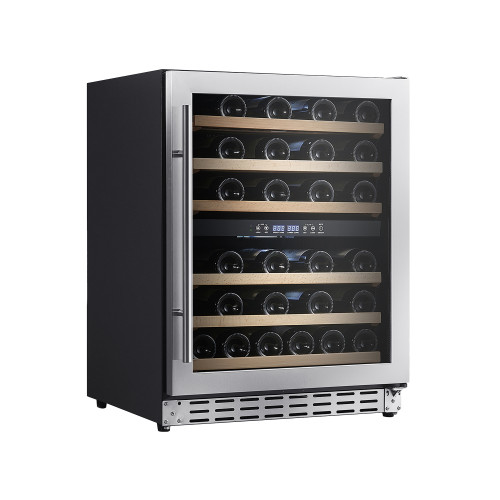
A dual-zone wine cooler provides two independently controlled temperature areas.
This makes it possible to store different types of wine under different temperature settings.
For premium residential kitchens, restaurants, wine bars, and hospitality applications, dual-zone models can provide additional flexibility.
Built-In Wine Cooler
Built-in wine coolers are designed specifically for integration into cabinetry or other furniture structures.
This product category is particularly attractive for modern kitchen projects because the appliance can be visually integrated into the surrounding design.
WIKI's product portfolio includes custom wine coolers as well as single-zone, dual-zone, home, and commercial configurations.
4. The Importance of Door and Handle Design
The wine cooler door is one of the most visible parts of the appliance.
For a modern kitchen, the door should coordinate with the surrounding cabinets and other appliances.
Popular design approaches include:
- · Black glass doors
- · Stainless steel framed glass doors
- · Seamless glass door designs
- · Stainless steel handles
- · Black cylindrical handles
- · Hidden or integrated handles
- · Handleless push-open concepts
For OEM/ODM customers, door and handle customization can be an important way to differentiate a product line.
WIKI's current OEM capabilities include customized logos, cabinet colors, handle designs, packaging, temperature configurations, and other product options.
This allows brands to start from an existing product platform while developing a wine cooler that better matches their own visual identity.
5. Shelving Is Both Functional and Aesthetic
Wine cooler shelves need to support bottles securely while also making the interior visually attractive.
Wooden shelves are particularly popular in premium wine coolers because they create a warmer, more sophisticated appearance than purely metal interiors.
Depending on the product design, manufacturers may provide different:
- · Shelf materials
- · Wood finishes
- · Shelf quantities
- · Shelf spacing
- · Bottle arrangements
- · Sliding or fixed shelf structures
For OEM/ODM projects, shelving can be customized according to bottle dimensions, storage capacity, target market, and overall product positioning.
WIKI specifically provides customization options for interior components such as shelving and wood types as part of its product development capabilities.
6. What Happens Behind the Cabinet?
From a consumer's perspective, a wine cooler may appear to be a simple appliance.
From a manufacturer's perspective, however, it is a carefully engineered refrigeration system.
A professional wine cooler manufacturer needs to coordinate multiple components, including:
- · Compressor cooling system
- · Refrigeration circuit
- · Temperature control
- · Insulation system
- · Door sealing
- · Glass structure
- · Condensation management
- · Internal airflow
- · Lighting
- · Shelving
- · Hinge system
- · Ventilation structure
- · Electrical components
- · Cabinet construction
The challenge becomes even greater when the appliance is designed for built-in installation.
The manufacturer must ensure that the cooling system and cabinet structure work together within the available installation space.
This is one reason why selecting an experienced built-in wine cooler manufacturer is important for large-scale OEM and ODM projects.
7. From Design to Assembly: How a Wine Cooler Is Manufactured
For an OEM/ODM customer, the manufacturing process generally begins long before the first production unit reaches the assembly line.
Step 1: Product Requirements
The customer provides requirements such as:
- · Target market
- · Product dimensions
- · Bottle capacity
- · Single or dual zone
- · Cooling technology
- · Door style
- · Handle design
- · Shelf configuration
- · Exterior finish
- · Electrical requirements
- · Branding requirements
Step 2: Engineering and Design
The manufacturer's engineering team evaluates the requirements and develops the product structure.
This stage may include cabinet design, refrigeration system configuration, door development, hinge design, shelf design, ventilation planning, and other engineering work.
Step 3: Prototype Development
A prototype or sample can then be developed for evaluation.
At this stage, manufacturers and customers can review the appearance, dimensions, functionality, installation requirements, and overall product experience.
Step 4: Testing and Quality Control
Before mass production, the product needs to undergo appropriate testing and quality inspections.
For WIKI, standardized quality control is supported by an ISO9001 quality management system. The company also states that its products meet certification requirements including CE, CB, ETL, SAA, and NSF for applicable products and markets.
Step 5: Mass Production
Once the product is approved, the manufacturer can move into mass production.
WIKI states that its wine cabinet manufacturing capacity can reach approximately 4,500 units per month, providing production support for international B2B customers.
8. Why Choose a Chinese Wine Cooler Manufacturer?
China has developed a highly integrated home appliance manufacturing ecosystem, and Shunde, Foshan is one of the major appliance manufacturing centers in the country.
For international buyers, working directly with a specialized Chinese manufacturer can provide several advantages:
Direct Factory Communication
Customers can communicate directly with engineering, production, and sales teams rather than relying entirely on trading intermediaries.
OEM/ODM Flexibility
A specialized factory can support customization across product appearance, dimensions, handles, shelves, doors, packaging, and other components.
Manufacturing Scale
Established manufacturers can provide more stable production capacity for distributors, retailers, and international brands.
Engineering Support
Experienced engineering teams can help customers identify potential issues before mass production.
Quality Control
A standardized factory quality management system provides a foundation for consistent manufacturing.
9. WIKI: More Than a Wine Cooler Factory
Foshan Shunde Wiki Electrical Co., Ltd. was established in 2014 and is located in Shunde, Foshan, Guangdong — an important center of China's home appliance industry.
The company specializes in built-in and vertical frost-free refrigeration appliances for both residential and commercial applications.
WIKI's product portfolio extends beyond wine coolers to include:
- · Wine Coolers
- · Beverage Coolers
- · Wine & Beverage Coolers
- · Refrigerators
- · Drawer Refrigerators
- · Freezers
- · Outdoor Refrigeration
This broader manufacturing capability allows WIKI to work with customers developing multiple refrigeration products rather than a single appliance category.
For B2B customers, the company also provides OEM/ODM services, cost estimation, product development support, IP protection policies, user manuals, and service support.
10. OEM/ODM Wine Cooler Solutions for Global Brands
For a brand owner or distributor, developing a wine cooler should not be viewed simply as purchasing an appliance.
It is a product development project.
The right manufacturing partner should be able to understand your target market and translate your requirements into a commercially viable product.
At WIKI, customers can work with an existing wine cooler platform or discuss customized product development.
Potential customization areas include:
Exterior Design
Cabinet color, door finish, glass design and overall appearance.
Brand Identity
Logo, labeling, packaging and other brand elements.
Handle Design
Different materials, shapes and finishes.
Interior Design
Wood type, shelf finish, shelf quantity and configuration.
Cooling Configuration
Temperature zones and other refrigeration requirements for qualified projects.
Product Dimensions
Different dimensions can be evaluated according to project requirements.
WIKI's official FAQ confirms that the company provides OEM/ODM wine cooler customization for B2B customers and operates as a direct manufacturer rather than a trading company.
11. A Successful Wine Cooler Starts with the Right Manufacturing Partner
Integrating a wine cooler into a modern kitchen requires coordination between interior design, appliance engineering, cabinet construction, refrigeration technology, and manufacturing.
For consumers, the result should be simple: a beautiful wine cooler that looks like it belongs in the kitchen.
For manufacturers and brands, achieving that result requires much more.
It requires experience.
It requires engineering.
And it requires a manufacturing partner capable of turning a product concept into a reliable finished appliance.
With more than a decade of experience in refrigeration manufacturing, Foshan Shunde Wiki Electrical Co., Ltd. continues to focus on wine coolers and built-in refrigeration appliances for international markets.
If you are a wine cooler brand owner, kitchen appliance distributor, importer, retailer, interior project developer, or OEM/ODM buyer, WIKI can provide product platforms and customized manufacturing solutions to support your next refrigeration project.
Explore WIKI's Built-In Refrigeration Solutions
Visit the official website of Foshan Shunde Wiki Electrical Co., Ltd. to explore wine coolers, beverage coolers, refrigerators, freezers, drawer refrigerators, and customized OEM/ODM refrigeration solutions:
WIKI – Built-In Refrigeration Appliances Manufacturer
Looking for a reliable Wine Cooler Manufacturer in China?
Contact WIKI to discuss your product requirements, OEM/ODM project, customization needs, and manufacturing plans.